
The consent banner for US health-data sites that aren't HIPAA-covered.
Washington's My Health My Data Act (MHMDA) and Nevada SB 370 require opt-in consent before collecting consumer health data, which can include quiz answers, symptom data, and behavior that suggests a health status, and separate consent before sharing it. Connecticut requires consent before processing it. CookieGuard's Healthcare plan includes controls built for these laws.
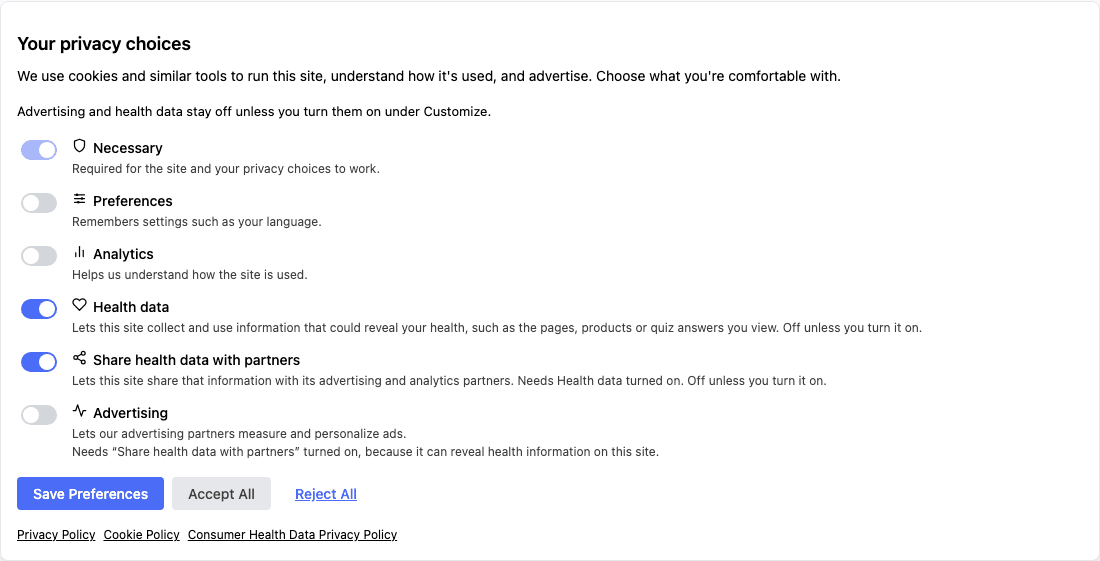
Separate choices to collect and to share
Health data and sharing it with partners are two separate choices, as Washington and Nevada require. Neither is ever pre-checked, Accept All never grants them, and Reject All denies them. Each decision records both, when, and which rules applied.
Ad pixels wait for health-data consent
Where health rules apply, marketing tags and Google's ad signals stay off until the visitor agrees to share health data, so one click on Accept All can't start ad tracking. You can hold analytics until health data is on, too.
Washington, Nevada and Connecticut, or wider
Switch on MHMDA, SB 370 or the Connecticut rule and visitors located there get an opt-in banner with the health-data choices. Extend it to all US visitors or everyone. It also applies when a visitor's location can't be determined.
Consent records you can export
Every decision stores which state rules applied and whether health data and sharing were granted, computed on the server. Records are kept while your site is active and export as CSV or JSON.
Your health-data policy, linked
Add your Consumer Health Data Privacy Policy and the banner links it wherever health rules apply, next to your privacy and cookie policies.
Works with GTM and direct pixels
Pushes Google Consent Mode v2 signals. Tag scripts with data-cookieguard, or use the JS API (on('change'), registerIntegration) to gate Meta Pixel, Mixpanel, PostHog and affiliate pixels that load outside GTM.
How it works
- Step 1
Switch on the state rules you need
In your site's Compliance settings, turn on Washington (MHMDA), Nevada (SB 370) or Connecticut. Choose whether they apply only in those states, to all US visitors, or to everyone.
- Step 2
Decide what needs health-data consent
By default, marketing tags need consent to share health data. You can also hold analytics until health data is on, and add your Consumer Health Data Privacy Policy link.
- Step 3
Install once, and keep the records
Add the script to your site and gate tags by category. Each visitor's choice is recorded on the server, ready to export.
Who this is for
- Telehealth funnels and DTC pharma intake (including GLP-1 weight-loss flows)
- Mental-health and behavioral-health services marketing to consumers online
- Fitness, nutrition, sleep, and recovery products with health claims
- Femtech, fertility, and reproductive-health services
- Symptom-checker quizzes and triage tools that profile users
Who it isn't for
- HIPAA covered entities and business associates handling protected health information on those pages: CookieGuard doesn't sign BAAs
- Sites that run Google AdSense, Ad Manager or AdMob for visitors in the EEA, UK or Switzerland, which need an IAB TCF certified CMP
- Mobile apps: CookieGuard covers websites and web apps
State health-data laws
| State | Law | CookieGuard |
|---|---|---|
| Washington | My Health My Data Act | Supported: health-data choices for Washington visitors |
| Nevada | SB 370 (NRS 603A) | Supported: health-data choices for Nevada visitors |
| Connecticut | Data Privacy Act, consumer health data | Supported: health-data choices for Connecticut visitors |
| Maryland | Online Data Privacy Act | Limits health data to what's strictly necessary, whatever the consent; a banner isn't the fix |
| New York | Health Information Privacy Act | Passed the legislature in June 2026; not yet signed into law |
Guides
Washington's My Health My Data Act and your website
Who it covers, what counts as consumer health data, and what it requires before collecting or sharing it.
Read the guide →Nevada SB 370 and consumer health data
Nevada's rules, and how they compare with Washington's and Connecticut's.
Read the guide →Tracking pixels on telehealth and health websites
HHS guidance after AHA v. Becerra, the FTC's health-data cases, and practical steps.
Read the guide →Recipe: gate pixels on consent (Nuxt 3 + GTM + Meta Pixel)
Gate third-party scripts on consent without rewriting tag attributes. With health-data mode on, the marketing category is only granted together with consent to share health data wherever health rules apply, so the Meta Pixel below waits for it. Scripts that should only ever run with health-data consent can check the sensitive categories directly.
// Anywhere in your app — e.g. plugins/cookieguard.client.ts
const init = (consent) => {
  if (!consent) return
  if (consent.categories.analytics) {
    // GA4
    useScript('https://www.googletagmanager.com/gtag/js?id=G-XXX')
  }
  if (consent.categories.marketing) {
    // Meta Pixel. Where health rules apply, marketing implies consent to share health data.
    useScript('https://connect.facebook.net/en_US/fbevents.js')
  }
  if (consent.categories.sensitive) {
    // Tools that should only ever see health data with explicit consent
    initHealthFeatures()
  }
}

// Drain queued handlers + listen for future changes
window.cookieguard = window.cookieguard || { q: [], on(...a) { this.q.push(['on', a]) } }
window.cookieguard.on('ready', init)
window.cookieguard.on('change', init)
What CookieGuard does — and does not — cover
CookieGuard manages consent for cookies, pixels, and client-side tracking scripts. We push Google Consent Mode v2 signals, expose a JS API for direct-loaded pixels, and write server-normalized, exportable consent records.
We do not gate server-side data flows, the contents of your quiz / form submissions, or data you share downstream with affiliates, CRMs, or warehouses. These laws apply to those flows too, and honoring them is your responsibility.
CookieGuard is not a DPO, not legal advice, and not HIPAA-certified, and we don't sign business associate agreements (BAAs). If you're a HIPAA covered entity or business associate handling protected health information, CookieGuard isn't the right tool for those pages.
Questions
- Which visitors see the health-data choices?
- Visitors located in the states whose rules you switch on (Washington, Nevada, Connecticut), or all US visitors, or everyone, depending on your setting. They also see them when their location can't be determined, unless you set the unknown-location fallback to implicit.
- What happens when a visitor clicks Accept All?
- Where health rules apply, Accept All allows preference cookies and analytics, but not health data, sharing it, or marketing tags. Google's ad signals stay denied. The visitor can turn those on individually under Customize.
- Does CookieGuard sign business associate agreements (BAAs)?
- No. CookieGuard isn't HIPAA-certified and doesn't sign BAAs, so it isn't the right tool for pages that handle protected health information for a HIPAA covered entity or business associate.
- Does CookieGuard control what my servers send to ad platforms?
- No. CookieGuard manages consent in the browser. Server-side event APIs, customer-list uploads, form submissions and CRM syncs need their own review against these laws.
- How is the Healthcare plan priced?
- It's quoted for each customer, starting at $89/month or $890/year for 1 website and 100,000 monthly pageviews. More websites and higher limits are available. Final pricing depends on traffic and compliance scope.
Healthcare plan: custom-quoted, starting at $89/mo or $890/yr for 1 website and 100,000 monthly pageviews. More websites and higher limits are available by quote. Final pricing depends on traffic and compliance scope.